Showing posts with label vintage sewing. Show all posts

Thursday, April 3, 2014

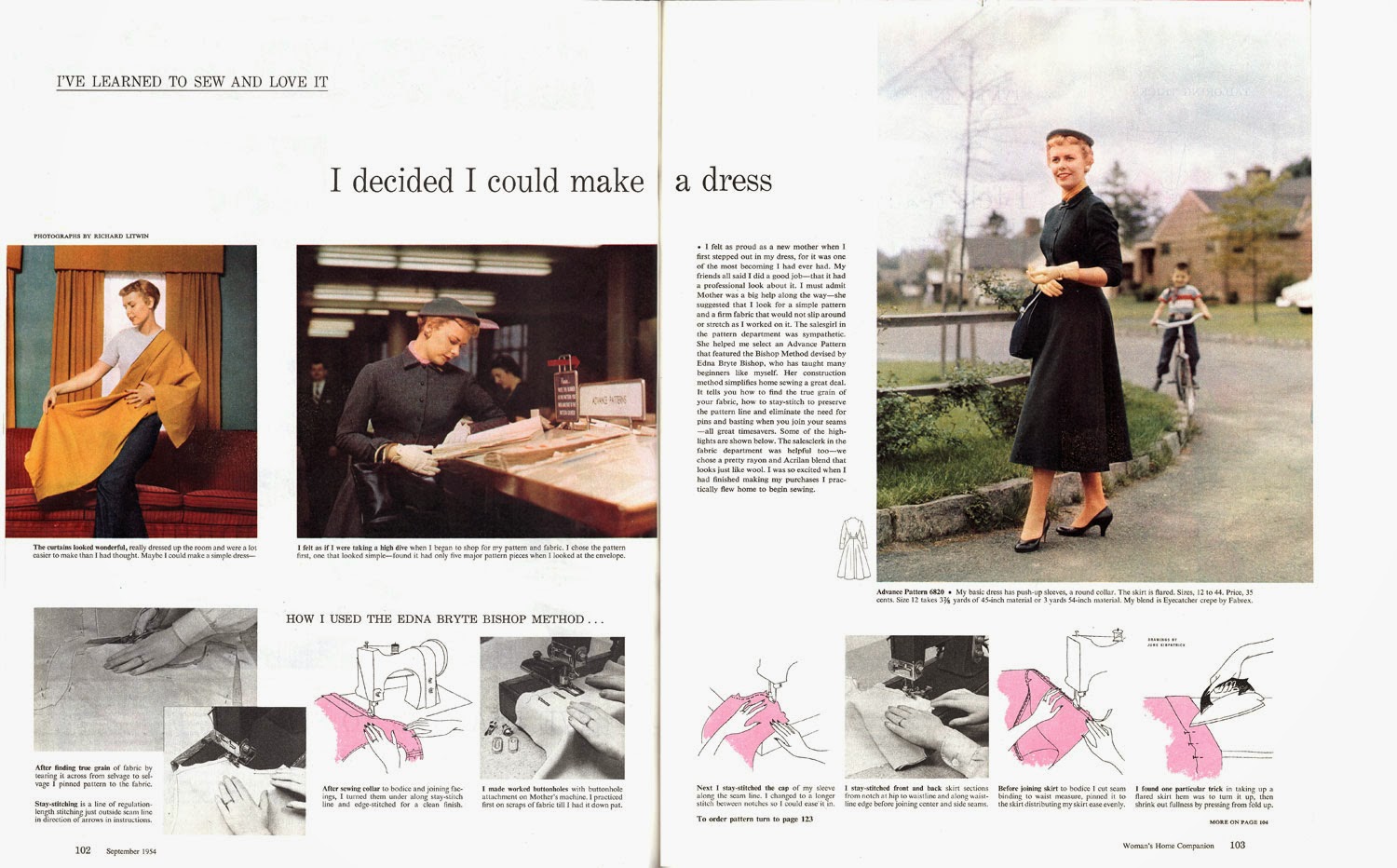
I'VE LEARNED TO SEW AND LOVE IT from Woman's Home Companion

Woman's Home Companion, a monthly ladies magazine published from 1873 to 1957, began as The Home Companion, then Ladies Home Companion and finally settled on Woman's Home Companion in 1897. Woman's Home Companion was a fitting name for a magazine that would bring not only useful homemaking tips, recipes and sewing and needlework patterns to both rural and urban women, it also brought articles about fashion, health issues, marriage and fiction. An amazingly long life for a magazine. You can find past issues for sale on the internet and they are well worth the price. They are packed with still useful information and the graphics alone are a delight to revisit.

This "Companion Picture Book" from September 1954 is an illustrated journey that Barbara Schultz embarked on. Through these pages, Barbara shares how she began and how she quickly became hooked on sewing. The Advance patterns she chose are now rare but may still be available through internet searches. Her advice for purchasing a machine is still relevant 60 years later, though I doubt she would have anticipated the complexities of today's machines. 


Advance 6820


Advance 6837 Advance 6846


Advance 6748 Advance 6836


Advance 6849 

Find more 1950's Advance and other 1950's dress patterns in my CynicalGirl shop on Etsy.

Tuesday, April 1, 2014

The Scarf Blouse

The Scarf Blouse
Transforming a square scarf into an easy to sew blouse is easy! The concept is not new. Women have been upcycling, repurposing and reusing to make do when budgets and availability necessitate it. This 1940's Mail Order pattern shows how to cut and sew an ordinary scarf into a day or evening blouse. Download HERE.

There are many of these patterns floating around. Cassie Stephens blog posts another way to tackle this project HERE.

Make do and have fun!

Sunday, October 27, 2013

USDA Agricultural Extension Bulletins


Extension work began as early as 1785. It was developed as a means to reach out to rural America and assist with aspects of farm management and education for the isolated families. Early Farmers' Institutes were established for the dissemination of information on Agriculture, Manufacturing and Arts. Speakers traveled around the country doing demonstrations, conducting classes and handing out informational publications. Topics such as soil analysis, geological surveys and chemical inventions were brought to the countryside. Topics expanded to cover aspects of animal husbandry, pasturing, crops, fencing, manures and market fairs. These institutes would develop into the State Agricultural Colleges throughout the country as the Market Fairs would become the State Fairs.

http://thelaker.com/yesterday-history-of-the-agricultural-fair

In the early 1900's the Institutes would sometimes hold separate sessions titled "Cooking Schools" for women where nutrition and methods of food preparation were demonstrated. Women were encouraged to attend and the number of women lecturers grew. Sessions were arranged for children to participate in any number of features such as music and arts. As popularity of the programs grew so did the funding.

By 1908 Iowa, Indiana, Colorado and Nebraska and many other rural states, had women's organizations with trained instructors in home economics. Many of these women's "auxiliaries" offered prizes for girl's culinary exhibits at the farmers' institutes. They met and had annual dues to support the expenses of their meetings and workshops. At the same time the farming institutes began separate institutes to encourage farming in the younger generation. Boys were instructed in farm work while girls were instructed in home arts and personal hygiene.


1927 Vocational Tech Classes - Wisconsin

By 1916 the "Institutes" began to decline. The work they had carried out was now part of larger Agricultural Colleges. Home demonstration work among farm women was gaining in popularity while women were schooled in small scale poultry management and vegetable gardening, butter making and developing cooperatives for selling eggs and other products. It was the birth of wide spread home economics study. The colleges reached women by offering study clubs, demonstrations and printed Bulletins. 


Clothing Construction 1925 - Google Doc


This publication from 1925 details the process of instructing various techniques of pattern drafting and dress form construction throughout several states. It does not teach the art of clothing construction, rather it is the report detailing the success of the Extension program.

Though many of the original institutes no longer exist, their offspring are thriving. Home economics are in the curricula of most high schools in the US. Clubs such as 4-H, Boys and Girls Clubs, and Scouting offer kids the opportunity to experience agriculture, nature and the arts. University Agricultural Extension services still produce informational bulletins with information that ranges from home canning and turkey roasting safety to pond management, growing mushrooms and orchard management. All of these publications are government printings and are in the public domain. 

During the Depression, as part of the WPA, similar visiting lecturers were employed by the government to visit rural communities and teach skills. John Colt, my professor of painting at the University of Wisconsin - Milwaukee, was one of these lecturers. He traveled around Wisconsin teaching rug weaving to women in small towns and rural areas. In the 40's this was one of the ways women could earn money and by the proliferation of old weaving looms stowed in old barns it was something that many women attempted.


1945 Women's Measurements USDA Publication


This 1941 publication on Women's Measurements was a product of the WPA. The entire documentation of the process of measuring and recording measurements is detailed in this publication. The standards for women's sizing would change again but the measurement guide and chart may still be of use especially for women sewing with vintage sewing patterns. 

Download the Sewing Chart HERE


I have a collection of many of the earlier bulletins which are still valuable for the detailed information contained in them. Click on any of the Vintage Sewing Booklets linked on the left or visit http://publications.usa.gov/ for current publications.


A History of Agricultural Extension Work in the United States 1785 - 1923 by Alfred Charles True published by the United States Government Printing Office - Washington 1928©
http://wiscohisto.tumblr.com/post/44669107621/sewing-class-at-milwaukee-vocational-school 
http://thelaker.com/yesterday-history-of-the-agricultural-fair

Thursday, October 10, 2013

Prims Masquerade 4 in 1 Hat Pattern

Another fab Prims pattern for you to download. Masquerade 4 in 1 Hat. Make it Pill Box or add a brim for your summer beach accessory. A nifty hood is smart for fall.


From the Home Economics Department of the William Prym Inc sewing notions company of Dayville, CT, now part of the Pryms/Dritz corporation. Visit my other Prims posts for more patterns from the inventor of the "Cover Your Own Buttons" and buckles too!


Monday, October 7, 2013

1958 Singer Measurement Chart - Fitting for Vintage Sewing

In 1956 the Pattern Industry issued new standards for pattern sizing. In 1958 the Singer Sewing Machine Company distributed this free chart for determining your perfect pattern size.


Standard sizing has changed since then, and many believe it is time for yet another change in what is considered standard sizing. But until then, here is a wonderful guide put out by The Simplicity, McCall's and Butterick Pattern Companies ©1996 to guide your pattern purchase.

Monday, September 30, 2013

1940's Cotton Day Dress

Rochelle from Lucky Lucille and Tasha from By Gum By Golly teamed up to host the Fall For Cotton Vintage Sew Along. I found myself with a free weekend and decided to tackle this lovely 1949 Advance dress pattern for my entry.


Advance 5185

I had been checking patterns to be sure they were complete to list in my Cynical Girl shop, and found this flared skirt dress pattern in a great size (though a little big for me), lacking instructions but still in it's original factory folds. This was the one. It was, after all, a vintage sewing challenge sew-along. I doubled up on the challenge part. An unprinted pattern with no instructions. Let the puzzle begin.


7:00 AM. My husband had just left for a writer's conference so I began, keeping the experience as vintage as possible. The fabric I chose was a piece of Cranston cotton I purchased over 30 years ago to make a copy of a vintage dress I really loved but never got to. It was perfect for this day dress. 


By 8:30 I had my pattern pinned, cut out, notched and marked.


I tried to find an 18" metal zipper in navy blue from my vintage stash but had to settle on a 22" navy or an 18" in cloister brown. I went with the blue.


Then the sewing began...... By 2:00 PM I had much of the larger pieces put together. The front facing and front of the bodice joined to make a shawl collar. That is one of my favorite types of collars so I had little difficulty figuring that part out without instructions. My 30+ year old Athena dress form isn't standing so straight any more. She is padded now with Fabulous Fit for that little extra I am carrying around now. It was a lot less expensive than purchasing a new dress form.


I decided not to serge my seams and instead use seam binding tape.


By 5:30 I had everything but the detail work to do. My pockets and buttons are pinned in place.


The buttons are vintage shell buttons upcycled from a vintage jacket that had seen better days. The buckle is shell as well. I will use white crochet cotton for the saddle stitching.

By 9:00 PM my dress was finished except for the marking and hemming.


And so I completed my Fall For Cotton Vintage Sewing Challenge. I entered it into the Flicker Fall For Cotton Group Page. So many lovely and just plain delightful entries into this challenge. I look forward to participating in another.

Friday, September 20, 2013

The Smocked Dress

 
Preen


Before elastic there was smocking. The art of folding and stitching fabric to allow stretch was often used in the collars and cuffs of garments for men, women and children. Any fabric that can be folded into pleats can be smocked. Smocking can also be used as a purely decorative element as well.


I remember wearing this sweet little dress with the smocked detail on the midriff section. This is my sister Ann wearing the dress. Our dresses passed down from cousin to sister to neighbor. What a lovely detail on this little cotton dress.

Years later I purchased this vintage dress at a thrift store. It was well worn but the detail at the yoke, pocket flaps and cuffs was so beautiful that I had to have it.


The front yoke shows a method of pintucking or more likely tuck pleats worked in a chevron pattern.


The pleats are machine stitched after carefully folding and pressing. These surface details transform this ordinary sheath style dress into a Couture garment.

Smocking as a garment detail for other than little girls dresses has come in and out of fashion. This lovely Anne Adams dress pattern from the 1930's with neckline and sleeve smocking details is one example.

Anne Adams 2365


Or this lovely gown featured in Threads magazine:


Threads Magazine Issue 167

The smocking on the back of this dress from Bottega Veneta creates fullness. Imagine this triangular smocked insert inverted on the back of a halter dress with the full skirt trailing behind.


Honeycomb Smocked Evening Skirt McCall's 1746


That same smocking detail is featured in this elegant and dramatic 1950's honeycomb smocked evening skirt from McCalls. Find it HERE on Etsy.

Or this simple elegance in the yoke of this Simplicity pattern from the 1960's:


Or this charming 1940's McCall smocked blouse pattern for women.


McCall 1406 ©1948


The Dritz Smockruler made the addition of smocked accessories and decor so much easier with it's easy to follow instructions. Now more than ever decor and fashions such as smocked hats and bags became easy to make. 


For more Smocking Patterns to Download for Free Click HERE


Many of these vintage sewing patterns are still available though becoming rarer.Click HERE for free downloadable patterns for accessories and decor.

Monday, September 9, 2013

1940's Prims Clothespin Caddy Pattern

The Prym sewing notions company traces back to the 16th century where it is the oldest family business in Germany. Hans Prym immigrated to America and in 1924 he established Prims, a sewing notions manufacturing firm as an autonomous offshoot of the historic Prym family business in Germany.  The Long Island plant expanded quickly and soon moved to a larger plant in Dayville, Connecticut. During World War II it's specialized machinery was applied to machine shop production of defense products. Today Pryms Consumer USA products include Prym Sewing, Dritz and others.

I have uncovered several patterns that originated from the Home Economics Department or the Educational Bureau of William Prym, Inc, as this one does. Probably dating around the late 40's because the company first introduced the "Cover-Your-Own" buttons, snaps and buttons after 1946. This little gem is a whimsical take on a once useful accessory. And what a creative way to sell buckles and buttons. 

I don't know how these patterns got into peoples hands. Were they high school Home-Ec projects? I have searched newspaper archives and they do not appear to have been mail order. I have several packages of the buttons and buckles and none have any offers for patterns. I did see an advertisement for a sewing fair that had representatives present from many companies including Singer and Prims. They were doing demonstrations of their products and perhaps that is where they originated? The mystery continues.


For a pattern and instructions to make this nostalgic clothespin caddy click HERE.